
August 2026
Equity markets reached fresh highs in August, driven by another strong month of earnings from companies tied to artificial intelligence, before a late-month shift in sentiment drove a partial pullback. The on-again-off-again Middle East ceasefire kept oil prices volatile throughout the month, with expectations of further interest rate rises pushing bond yields to their highest levels in nearly two decades.
At the time of writing, the US Federal Reserve has raised interest rates by 0.25% to a range of 3.75 – 4.00%, its first increase since 2023.
Economic Conditions
The Reserve Bank of Australia left the cash rate unchanged at 4.35% for a second straight month, as underlying inflation of 3.6% over the year to July increased the prospect of further rate rises later in the year. Unemployment continued to edge higher during the month.
In the United States, minutes from the Federal Reserve’s July meeting showed a rate rise was being seriously considered, while consumer prices rose only mildly as lower petrol prices offset a pickup in food costs. Bond markets came under enough pressure during the month that the US Treasury stepped up its own bond purchases and intervened directly in currency markets for the first time since 1998, after the Japanese yen fell to a 40-year low.
Equities
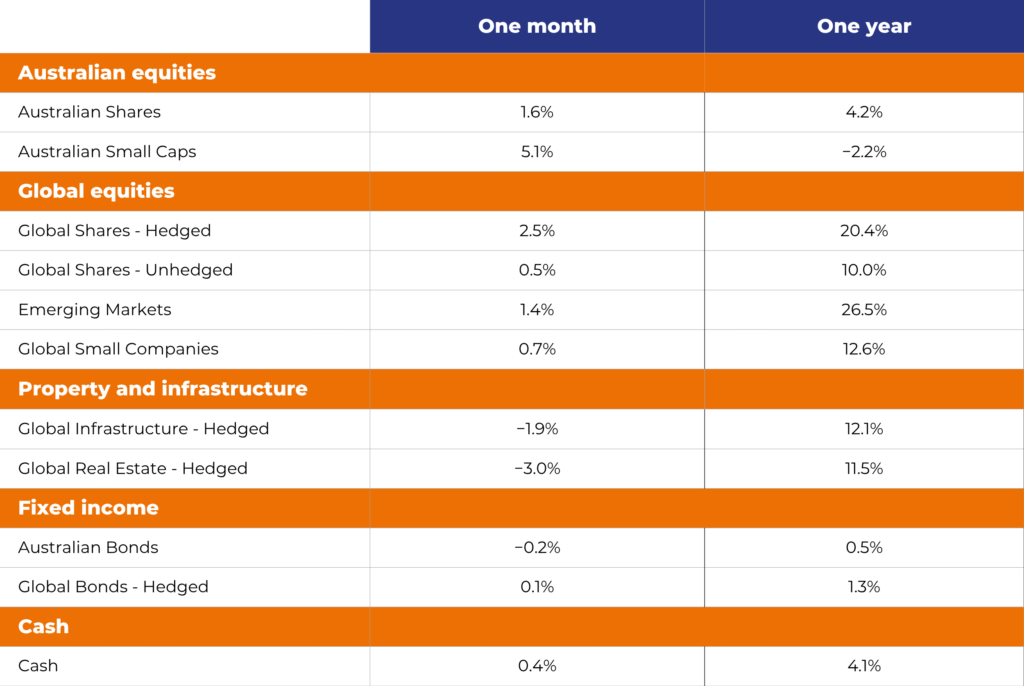
Global shares rose 2.5% for hedged investors but 0.5% for unhedged investors, as the Australian dollar appreciated during the month. Earnings continued to support the market, with 9 out of 10 large US (S&P 500) companies beating expectations this reporting season, the highest proportion on record.
Asian shares were volatile again in August, with South Korean and Taiwanese markets rebounding sharply from July’s sharp falls before giving back some of those gains as bond yields rose later in the month.
Australian shares rose 1.6%, with mining and energy companies leading gains on firmer commodity prices, while banks and property lagged on rising expectations of a Reserve Bank rate rise. Australian small companies rose 5.1% for the month, though remain down over the past year.
Fixed Interest
Long-term borrowing costs rose sharply around the world in August, as investors priced in further interest rate rises, ongoing concern about government debt levels, and heavy borrowing by technology companies investing in artificial intelligence. US government borrowing costs reached their highest level since 2007.
Australian bonds returned −0.2% for the month and global bonds (hedged) returned 0.1%, as the rise in long-term rates weighed on prices. Company borrowing costs stayed steady by comparison, a sign that businesses were not under financial strain.
With interest rates well above where they sat a few years ago, investors holding bonds and cash continue to earn a healthy level of income.
Winners & Losers
Real assets had a difficult month as long-term rates rose, with global infrastructure falling 1.9% and global real estate falling 3.0%. Australian listed property, an index in which a single company, Goodman Group, makes up close to 40% of the total weighting, fell further still, down 6.6% for the month and now down 15.2% over the past year.
Australian small companies were the standout for the month, rising 5.1% as key commodity prices (such as copper) firmed. Gold also surged 11% to around US$4,482 an ounce, as investors rotated out of a weakening US dollar and into safe-haven assets. The Australian dollar strengthened, helped by strength in key commodity prices, persistently high inflation and the prospect of higher local interest rates.
Asset class returns – August 2026
Importance of diversification
August served as a reminder that strong share markets don’t always tell the full story. Equities reached fresh highs on the back of artificial intelligence earnings, while government bond markets sent a more cautious signal, with rising long-term rates reflecting concern about government debt levels. Having a mix of investments helps capture growth while cushioning against risks building elsewhere, underlining the importance of diversification.