
September 2026
Share markets moved in different directions in September. Technology shares in the US and Asia continued to climb on strong profits from companies tied to artificial intelligence, while Australian shares fell. A further escalation in the Middle East conflict, including attacks on Saudi oil pipelines, sent oil above US$130 a barrel mid-month, adding to concern that inflation will stay higher for longer. Prices eased as talks between the US and Iran resumed, but inflation worries, along with further interest rate rises, pushed bond yields higher around the world.
Economic Conditions
The Reserve Bank of Australia raised its cash rate again in September, by 0.25% to 4.60%, its fourth increase this year and its highest level since 2011. Inflation rose to 4.0% in August from 3.5% in July, with petrol prices up 15% over the month. Higher fuel prices and fears of more rate rises pushed consumer confidence down 5.2%, while national dwelling values fell 3.1% over the past three months.
In the United States, the Federal Reserve lifted interest rates by 0.25% to a range of 3.75–4.00%, its first increase since 2023. Central banks in Europe and Japan also raised rates during the month.
Equities
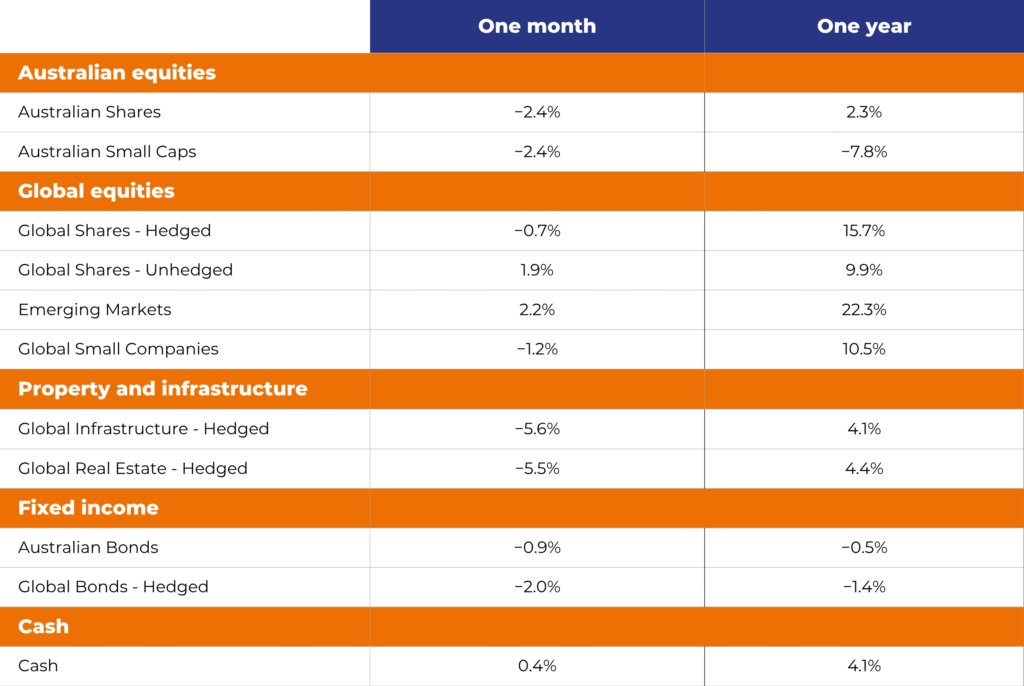
Global shares fell 0.7% for hedged investors but rose 1.9% for unhedged investors, as the Australian dollar fell 2.9%, increasing the value of overseas investments in Australian dollar terms.
Gains were concentrated in a narrow group of companies. Technology and communication services led the US market, while most other sectors fell. Company profits remained strong, with forecast earnings for large US (S&P 500) companies up 28% this year, well ahead of the 13% rise in their share prices. Taiwan and South Korea, home to major makers of the computer chips behind artificial intelligence, rose, helping emerging markets return 2.2%, while China and India fell.
Australian shares fell 2.4%, with small companies down by a similar amount, as rising interest rates and higher oil prices weighed on the market. Technology companies, miners and retailers led the declines, while health care companies held up better. Australian companies are due to pay nearly $40 billion in dividends over the next two months, reversing two years of declining payouts.
Fixed Interest
The yield on 10-year US government bonds reached 5.2% in late September, a level last seen before the global financial crisis in 2007, while the equivalent Australian yield touched 5.4%. Rising interest rates, higher energy prices feeding into inflation, and ongoing concern about government borrowing all pushed yields higher, with yields on shorter-term bonds, which are most sensitive to central bank decisions, rising the most. Large technology companies also borrowed at record levels to fund investment in artificial intelligence, adding to the supply of bonds competing for investors’ money.
When yields rise, the value of existing bonds falls, because newly issued bonds pay a higher rate of interest. Australian bonds returned −0.9% for the month and global bonds (hedged) returned −2.0%.
Higher yields also mean investors holding bonds and cash are earning a healthy level of income, and the return they receive after inflation has improved.
Winners & Losers
Real assets fell sharply in September, with global listed infrastructure down 5.6% and global listed real estate down 5.5%, a second consecutive month of declines for both. These investments tend to come under pressure when bond yields rise, as higher rates lift their borrowing costs and make their steady income less attractive compared with bonds. Within infrastructure, assets such as toll roads often have revenues linked to inflation, while utilities face rising costs against relatively fixed revenues when inflation is high. Both asset classes remain positive over the past year, with infrastructure up 4.1% and real estate up 4.4%.
Gold also fell as higher yields and a stronger US dollar outweighed demand for safe-haven assets. Copper reached a record high on demand from data centres and power networks.
Asset Class Returns – September 2026
Spreading the risk
September showed the value of looking beyond any one market. Rising interest rates weighed on Australian shares, bonds, property and infrastructure, while global shares held without currency hedging, emerging markets and cash all finished the month higher. No single investment leads every month, and spreading money across regions, currencies and asset types reduces the reliance on any one of them to deliver returns.